Latest News on Election
Inside Burma
12 Aug 2010
Yangon, August 12 -- Though the long-awaited date for elections has not yet been declared for 2010 general elections, so far 46 political parties have submitted applications to the Union Election Commission ( UEC ) to form and to exist as political parties.
According to the latest announcement made by the UEC, out of 46 political parties that have submitted applications to form and exist as political parties, 40 parties including the all powerful government’s party namely the Union Solidarity and Development Party ( USDP ) have been granted permission to register as political parties.
“The remaining six political parties are still under scrutiny for receiving the permission to register as political parties,” the announcement said.
The Union Solidarity and Development Party ( USDP ), which was formed by Prime Minister U Thein Sein and 26 other ministers and deputy ministers, who have resigned from the military posts to contest in the elections, is still by far and large the biggest and most powerful political party.
The ( USDP ) has already opened its headquarters in Nay Pyi Taw and is currently busy opening its branches throughout the country.
From among the 10 existing political parties, which had been operating for over two decades upto April this year, five political parties including pro-government National Unity Party ( former Burma Socialist Programme Party of the late General Ne Win ) have chosen to apply for their continued existence.
Hence, all these five political parties were included among 40 political parties that have been granted permission by UEC to register.
The five political parties that have boycotted 2010 elections were Aung San Suu Kyi’s National League for Democracy ( NLD ), Shan Nationalities League for Democracy ( SNLD ), Union Paoh National Organization, Shan State Kokang Democratic Party and Wa National Development Party.
Meanwhile the Union Election Commission ( UEC ) this morning designated constituencies for Pyithu Hluttaw ( House of Representatives ), Amyotha Hluttaw ( House of Nationalities ), Region and State Hluttaws.
This morning’s issue of state-owned newspapers carried a supplement showing 330 constituencies for Pyithu Hluttaw throughout Myanmar.
This is in accordance with the 2008 State Constitution, which prescribes that the Pyithu Hluttaw shall have 330 elected members plus 110 military men nominated by the Commander-in-Chief of Defence Services.
Tomorrow’s issue of state-owned newspapers is expected to carry supplement showing constituencies for Amyotha Hluttaw ( House of Nationalities ) and Region and State Hluttaws.
Note: Special thanks to the news sender from Burma Democratic Concern (BDC)
Thursday, 12 August 2010
Tuesday, 10 August 2010
Saturday, 7 August 2010
22nd Anniversary of 8888 or Burma Unfinished Revolution
22nd Anniversary of 8888 or Burma Unfinished Revolution
Please come along and support Burma
Date: Sunday, 08 August 2010
Time: 09:00 to 17:00
Venue: Room G2, Russell Square Campus
School of Oriental and African studies University of London
Thornhaugh Street Russell Square London
WC1H OXH
- Brief commemoration of 8888
- Short Video show
-Photo Exhibition
-Competition on strategy of how to breakthrough current appalling situation in Burma toward real freedom ...
For more information
Phone: 07958314687,07762094562,07727248755
Source: http://www.bdcburma.org/EventDetails.asp?msg_id=106
No sign Burma’s coming election will be free, fair
THE people of Burma, whose dictatorial junta prefers their country to be called Myanmar, has been in the grip of its military rulers since 1962.
Burma has not had an election since 1990. By a landslide Aung San Suu Kyi’s National League for Democracy (NLD) won that election. But the junta rejected the election results and even put her and her fellow pro-democracy activists in jail.
She has been in prison or under house arrest, with ever so brief periods of temporary liberty, these past 20 years. The junta has been adding trumped up charges against her through the years. Her allies have not been much luckier.
Except China, the socialist-Buddhist Burmese military leaders’ friend and supporter, and of late India, virtually all the countries of the world have been begging the Burmese junta to free Aung San Suu Kyi, to give back the Burmese people their political and economic freedoms and allow them to exercise their basic human rights. Their pleas, and the entreaties of UN and Asean envoys, have fallen on deaf ears.
Nargis bared junta’s self-serving cruelty
Through the years, most Burma watchers—seeing Aung San Suu Kyi’s oppression and the generals’ cruelty to their own people—have come to despise the military junta. This sentiment grew in the aftermath of the catastrophic Cyclone Nargis in 2008.
Nargis destroyed much of Burma’s Irrawaddy Delta and areas of the capital Rangoon (which the generals now call Yangon), lands and people so beautiful and romantic in the stories, novels and poems of Rudyard Kipling and George Orwell. The 160-kilometer winds and heavy rains killed more than 140,000 and destroyed the crops. There was a humanitarian disaster.
The military junta did nothing to rescue the victims. And when planeloads and shiploads of aid came from the rest of mankind, the junta refused to let food, medicine and supplies to be taken by Red Cross and other aid workers to the starving, injured, and homeless Burmese people. The generals were afraid that the foreign bearers of rescue and food packages would turn out to be like Greeks in the Trojan horse.
Elections before end of 2010 a PR exercise
On Thursday, the head and co-founder a new pro-democracy party that was formed to participate in elections Burma’s dictators promised to hold before the end of the year, resigned. Phyo Min Thein, who had been imprisoned for 15 years for joining the bloody 1988 uprising, said, “I do not believe the coming elections will be free and fair.”
What he belatedly came to realize was what wiser and less optimistic pro-democracy Burmese knew at once on reading the so-called “democratic constitution” the junta had prepared for the country. The election rules released last March and the appointment of an untrustworthy set of officials to serve as election commissioners sealed the decision of Aung Sun Suu Kyi and her NLD members not to participate in the election.
What made it obvious that the coming election was nothing more than a public relations gimmick was the junta’s rule that people who have been convicted by the junta of crimes, like Aung San Suu Kyi herself, are disqualified from running for office. This was the generals’ way of making sure Suu Kyi would not ever come out again as the Burmese people’s chosen leader.
On top of these rules obviously skewed against the opposition parties, the junta also did something to make their political party the sure winner. There is in Burma a junta-approved mass-based welfare society, the Union Solidarity and Development Association (USDA). It has 24 to 26 million members. It is the body through which services and doles from the government get to the poor—meaning the members. The generals recently formed a political party called the Union Solidarity and Development Party (USDP). The USDA and the USDP were merged, with the social welfare society being subsumed in the political party.
This is the junta’s way of dominating the election. This made foreign observers—the Human Rights Watch, Amnesty International, various European and Asian organizations—condemn the coming elections as nothing but a farce.
“The morphing of Burma’s largest mass-based organization with the military’s political party is a brazen if predictable distortion of the electoral process,” said Elaine Pearson, acting Asia director at Human Rights Watch, last month. “The future of military rule is being shamelessly scripted and played out before our eyes.”
USDA-USDP and the Ton-ton Macout
Human Rights Watch says the military junta has long used the USDA for partisan political purposes. Since the 1990s USDA members have been marching and demonstrating throughout the country. They deliver speeches denouncing Aun San Suu Kyi and the NLD and other opposition parties. They attack the United States, the International Labor Organization and of course extol the virtues of the generals. Burma’s Senior General Tan Shwe is the USDA’s main patron. Its secretary general is U Htay Oo, a retired general who is now the minister for agriculture and irrigation.
The USDA carried out violent attacks on Aung San Suu Kyi in 1996 and 1997. It launched violent mob action against a National League for Democracy motorcade in May 2003. Scores died in that attack. During peaceful demonstrations in August and September 2007, USDA thugs intimidated the pro-democracy protestors. The USDA, now merged with the USDP, joined junta security forces that violently cracked down on Buddhist monks perceived to be anti-government in September 2007.
Doesn’t this remind one of the Ton-Ton Macout in the Duvaliers’ Haiti?
Aung San Suu Kyi and her NLD loyalists are right. The election is meant to give the world the false impression that democracy has returned to Burma.
The Philippines, alone, if fellow Asean countries do not wish to take risks, must help intensify international pressure on Burma’s junta, keep on urging it to release political prisoners and enter into an honest dialogue to achieve reconciliation with the opposition. The aim is to make Burma a normal and beautiful nation again.
Source:http://www.manilatimes.net/index.php/component/content/article/83-opinion-columnist/23204-no-sign-burmas-coming-election-will-be-free-fair
The manila Times
Burma has not had an election since 1990. By a landslide Aung San Suu Kyi’s National League for Democracy (NLD) won that election. But the junta rejected the election results and even put her and her fellow pro-democracy activists in jail.
She has been in prison or under house arrest, with ever so brief periods of temporary liberty, these past 20 years. The junta has been adding trumped up charges against her through the years. Her allies have not been much luckier.
Except China, the socialist-Buddhist Burmese military leaders’ friend and supporter, and of late India, virtually all the countries of the world have been begging the Burmese junta to free Aung San Suu Kyi, to give back the Burmese people their political and economic freedoms and allow them to exercise their basic human rights. Their pleas, and the entreaties of UN and Asean envoys, have fallen on deaf ears.
Nargis bared junta’s self-serving cruelty
Through the years, most Burma watchers—seeing Aung San Suu Kyi’s oppression and the generals’ cruelty to their own people—have come to despise the military junta. This sentiment grew in the aftermath of the catastrophic Cyclone Nargis in 2008.
Nargis destroyed much of Burma’s Irrawaddy Delta and areas of the capital Rangoon (which the generals now call Yangon), lands and people so beautiful and romantic in the stories, novels and poems of Rudyard Kipling and George Orwell. The 160-kilometer winds and heavy rains killed more than 140,000 and destroyed the crops. There was a humanitarian disaster.
The military junta did nothing to rescue the victims. And when planeloads and shiploads of aid came from the rest of mankind, the junta refused to let food, medicine and supplies to be taken by Red Cross and other aid workers to the starving, injured, and homeless Burmese people. The generals were afraid that the foreign bearers of rescue and food packages would turn out to be like Greeks in the Trojan horse.
Elections before end of 2010 a PR exercise
On Thursday, the head and co-founder a new pro-democracy party that was formed to participate in elections Burma’s dictators promised to hold before the end of the year, resigned. Phyo Min Thein, who had been imprisoned for 15 years for joining the bloody 1988 uprising, said, “I do not believe the coming elections will be free and fair.”
What he belatedly came to realize was what wiser and less optimistic pro-democracy Burmese knew at once on reading the so-called “democratic constitution” the junta had prepared for the country. The election rules released last March and the appointment of an untrustworthy set of officials to serve as election commissioners sealed the decision of Aung Sun Suu Kyi and her NLD members not to participate in the election.
What made it obvious that the coming election was nothing more than a public relations gimmick was the junta’s rule that people who have been convicted by the junta of crimes, like Aung San Suu Kyi herself, are disqualified from running for office. This was the generals’ way of making sure Suu Kyi would not ever come out again as the Burmese people’s chosen leader.
On top of these rules obviously skewed against the opposition parties, the junta also did something to make their political party the sure winner. There is in Burma a junta-approved mass-based welfare society, the Union Solidarity and Development Association (USDA). It has 24 to 26 million members. It is the body through which services and doles from the government get to the poor—meaning the members. The generals recently formed a political party called the Union Solidarity and Development Party (USDP). The USDA and the USDP were merged, with the social welfare society being subsumed in the political party.
This is the junta’s way of dominating the election. This made foreign observers—the Human Rights Watch, Amnesty International, various European and Asian organizations—condemn the coming elections as nothing but a farce.
“The morphing of Burma’s largest mass-based organization with the military’s political party is a brazen if predictable distortion of the electoral process,” said Elaine Pearson, acting Asia director at Human Rights Watch, last month. “The future of military rule is being shamelessly scripted and played out before our eyes.”
USDA-USDP and the Ton-ton Macout
Human Rights Watch says the military junta has long used the USDA for partisan political purposes. Since the 1990s USDA members have been marching and demonstrating throughout the country. They deliver speeches denouncing Aun San Suu Kyi and the NLD and other opposition parties. They attack the United States, the International Labor Organization and of course extol the virtues of the generals. Burma’s Senior General Tan Shwe is the USDA’s main patron. Its secretary general is U Htay Oo, a retired general who is now the minister for agriculture and irrigation.
The USDA carried out violent attacks on Aung San Suu Kyi in 1996 and 1997. It launched violent mob action against a National League for Democracy motorcade in May 2003. Scores died in that attack. During peaceful demonstrations in August and September 2007, USDA thugs intimidated the pro-democracy protestors. The USDA, now merged with the USDP, joined junta security forces that violently cracked down on Buddhist monks perceived to be anti-government in September 2007.
Doesn’t this remind one of the Ton-Ton Macout in the Duvaliers’ Haiti?
Aung San Suu Kyi and her NLD loyalists are right. The election is meant to give the world the false impression that democracy has returned to Burma.
The Philippines, alone, if fellow Asean countries do not wish to take risks, must help intensify international pressure on Burma’s junta, keep on urging it to release political prisoners and enter into an honest dialogue to achieve reconciliation with the opposition. The aim is to make Burma a normal and beautiful nation again.
Source:http://www.manilatimes.net/index.php/component/content/article/83-opinion-columnist/23204-no-sign-burmas-coming-election-will-be-free-fair
The manila Times
Tuesday, 3 August 2010
Monday, 2 August 2010
B.D.C's WISHING SCROLL ON 8888-CEREMONY
B.D.C's WISHING SCROLL ON 8888-CEREMONY
NORTH CARROLINA
U.S.A.
(8-8-2010 )
Dear commarades & friends;
22nd,Anniversary of our Burma's greatest 8888-democratic movement will exist on 8-8-2010.Last 22-yrs,our all Burma's national people's movement might move single party didtactorship system of Burma Socialist Programme Party(B.S.P.P) of Burma Junta Regime on 8-8-88 and got also Multi-parties system & Marketing ecnomy under military didtactorship system but Burma Junta Regimes gave only form not content as Socalled socialisim of U Ne Win and continnued to control the content of military didtactorship system for their didtactorship dynesty for 22-years with SLORC & SPDC.
In 1990,although SLORC had to hold General election according to democratic demands of 8888-movement,SPDC didn't power-transfer to 90-elected boddy of NLD with many kinds of reasons on military's salaved constitution of Artificial National Convention.
According to demaging of all Burma's democratic forces,Burma Junta Regimes arrested,killed & sentenced many democratic leaders,politicians,activits,students,monks,workers, peasants and national peoples for over 20-years.(For example! Daw Aung Su Kyi,Min Ko Naing & other politicians.) and then attacked & demaged all Burma's national people's revolutionarry forces and deregistrated over 200-parties and persuaded & organized national democratic revolutionarry forces with regional peace & developments and then politically asylemed under unbrellas of International didtactors( China & Russia).In this way,SPDC counter-attacked global democratic forces(U.S,U.K& E.U) on the biggest round table discussion of United Nations.
SPDC could build up the biggest army on our Burma's natural resources & enrichs and their army might be armed by the weapons of China,Russia & North Koreia and forced to get the enrichs of peacefull groups and disorganized the arm forces of peacefull groups and built up more & more biggest Kyintphwint(Swanahashin) towards Kyintphwint party and divided & demaged NLD with UNLD and then forced to push their back bones parties on 2010-election of 2008-military's salaved constiotution and changed their military's uniforms into civilian's uniforms for next civilian government of 2010-election.In this way,they increased 1/4 % of MP to 90% of MP and so, the registrated parties will be only services for SPDC but can not more do for all Burma's national people's demo-humanrights.
Therefore! we need to move absolutely the hole military didtactorship system by all Burma's national people's democratic forces on NLD's honest democratic boycott road map with global democratic forces and we shall have to march towards global democratic Burma's society with the soils of 8888-democratic heroes.
Let to long alive the history of our greatest 8888-democratic movement.
We salute all myters with Bojoke Aung Sann.
best regard;
(U Thi Ha Tint Swe)
Patron for Burma Democratic Concern(B.D.C),WA-99336,U.S.A.
Ph;(509)5823261.
NORTH CARROLINA
U.S.A.
(8-8-2010 )
Dear commarades & friends;
22nd,Anniversary of our Burma's greatest 8888-democratic movement will exist on 8-8-2010.Last 22-yrs,our all Burma's national people's movement might move single party didtactorship system of Burma Socialist Programme Party(B.S.P.P) of Burma Junta Regime on 8-8-88 and got also Multi-parties system & Marketing ecnomy under military didtactorship system but Burma Junta Regimes gave only form not content as Socalled socialisim of U Ne Win and continnued to control the content of military didtactorship system for their didtactorship dynesty for 22-years with SLORC & SPDC.
In 1990,although SLORC had to hold General election according to democratic demands of 8888-movement,SPDC didn't power-transfer to 90-elected boddy of NLD with many kinds of reasons on military's salaved constitution of Artificial National Convention.
According to demaging of all Burma's democratic forces,Burma Junta Regimes arrested,killed & sentenced many democratic leaders,politicians,activits,students,monks,workers, peasants and national peoples for over 20-years.(For example! Daw Aung Su Kyi,Min Ko Naing & other politicians.) and then attacked & demaged all Burma's national people's revolutionarry forces and deregistrated over 200-parties and persuaded & organized national democratic revolutionarry forces with regional peace & developments and then politically asylemed under unbrellas of International didtactors( China & Russia).In this way,SPDC counter-attacked global democratic forces(U.S,U.K& E.U) on the biggest round table discussion of United Nations.
SPDC could build up the biggest army on our Burma's natural resources & enrichs and their army might be armed by the weapons of China,Russia & North Koreia and forced to get the enrichs of peacefull groups and disorganized the arm forces of peacefull groups and built up more & more biggest Kyintphwint(Swanahashin) towards Kyintphwint party and divided & demaged NLD with UNLD and then forced to push their back bones parties on 2010-election of 2008-military's salaved constiotution and changed their military's uniforms into civilian's uniforms for next civilian government of 2010-election.In this way,they increased 1/4 % of MP to 90% of MP and so, the registrated parties will be only services for SPDC but can not more do for all Burma's national people's demo-humanrights.
Therefore! we need to move absolutely the hole military didtactorship system by all Burma's national people's democratic forces on NLD's honest democratic boycott road map with global democratic forces and we shall have to march towards global democratic Burma's society with the soils of 8888-democratic heroes.
Let to long alive the history of our greatest 8888-democratic movement.
We salute all myters with Bojoke Aung Sann.
best regard;
(U Thi Ha Tint Swe)
Patron for Burma Democratic Concern(B.D.C),WA-99336,U.S.A.
Ph;(509)5823261.
Friday, 30 July 2010
U.S. Daily Press Briefing
Philip J. Crowley
Assistant Secretary
Daily Press Briefing
Washington, DC
July 29, 2010
CHINA/NORTH KOREA/BURMA
US expects China to live up to its international obligations/US wants to see China use its leverage with North Korea to encourage North Korea to move in a fundamentally different direction US has concerns about the nature of the relationship between North Korea and Burma
QUESTION: Also, do you have any comment on North Korean Foreign Minister Pak’s visit to Yangon today?
MR. CROWLEY: We have – as we’ve stated many times, we have concerns about the nature of the relationship between North Korea and Burma. We don’t see the transparency in that relationship that we’d like to see. North Korea is a serial proliferators. North Korea is engaged in significant illicit activity. Burma, like other countries around the world, has obligations, and we expect Burma to live up to those obligations.
QUESTION: But do you see North Korea indulging in nuclear proliferation with Burma, or do you see Burma has that ambition?
MR. CROWLEY: Again, there – we – it’s difficult to evaluate because of the lack of transparency in that relationship. It is something that is of concern to us, given North Korea’s historical record. And it is something that we continue to watch very carefully.
QUESTION: During your talks with the Burmese officials, has that issue been brought up with them or the –
MR. CROWLEY: Yes.
QUESTION: -- Burmese officials? Okay.
QUESTION: On Ambassador Einhorn’s trip to Asia, is he going to announce the new sanctions against North Korea while he’s in Asia, or do you expect that announcement after he comes back from the region?
MR. CROWLEY: I don’t think he’ll make any announcements while he’s out there.
Philip J. Crowley
Assistant Secretary
Daily Press Briefing Washington, DC
July 28, 2010
INDIA/BURMA
U.S. Spoke to India on the Nature of their Relationship with Burma / Hearing from Leaders in the Region
QUESTION: How do you view the visit of the senior general – Burmese Senior General Than Shwe – he is considered one of the worst dictators of the world – to India, the largest democratic country of the world?
MR. CROWLEY: Well, we recognize that India and Burma, as neighbors, they have a relationship. We have spoken to India about the nature of this relationship. We hope that India will use its leverage, its investment, to convince Burma and its leaders to improve its record regarding human rights and democracy. We think it’s important for Burma to hear not only from the United States, but also from other regional leaders, India foremost among them.
Assistant Secretary
Daily Press Briefing
Washington, DC
July 29, 2010
CHINA/NORTH KOREA/BURMA
US expects China to live up to its international obligations/US wants to see China use its leverage with North Korea to encourage North Korea to move in a fundamentally different direction US has concerns about the nature of the relationship between North Korea and Burma
QUESTION: Also, do you have any comment on North Korean Foreign Minister Pak’s visit to Yangon today?
MR. CROWLEY: We have – as we’ve stated many times, we have concerns about the nature of the relationship between North Korea and Burma. We don’t see the transparency in that relationship that we’d like to see. North Korea is a serial proliferators. North Korea is engaged in significant illicit activity. Burma, like other countries around the world, has obligations, and we expect Burma to live up to those obligations.
QUESTION: But do you see North Korea indulging in nuclear proliferation with Burma, or do you see Burma has that ambition?
MR. CROWLEY: Again, there – we – it’s difficult to evaluate because of the lack of transparency in that relationship. It is something that is of concern to us, given North Korea’s historical record. And it is something that we continue to watch very carefully.
QUESTION: During your talks with the Burmese officials, has that issue been brought up with them or the –
MR. CROWLEY: Yes.
QUESTION: -- Burmese officials? Okay.
QUESTION: On Ambassador Einhorn’s trip to Asia, is he going to announce the new sanctions against North Korea while he’s in Asia, or do you expect that announcement after he comes back from the region?
MR. CROWLEY: I don’t think he’ll make any announcements while he’s out there.
Philip J. Crowley
Assistant Secretary
Daily Press Briefing Washington, DC
July 28, 2010
INDIA/BURMA
U.S. Spoke to India on the Nature of their Relationship with Burma / Hearing from Leaders in the Region
QUESTION: How do you view the visit of the senior general – Burmese Senior General Than Shwe – he is considered one of the worst dictators of the world – to India, the largest democratic country of the world?
MR. CROWLEY: Well, we recognize that India and Burma, as neighbors, they have a relationship. We have spoken to India about the nature of this relationship. We hope that India will use its leverage, its investment, to convince Burma and its leaders to improve its record regarding human rights and democracy. We think it’s important for Burma to hear not only from the United States, but also from other regional leaders, India foremost among them.
Wednesday, 28 July 2010
Monday, 26 July 2010
23 July 2010 video discussion in London organized by Burma Democratic Concern (BDC)
Video discussions organized by Burma Democratic Concern (BDC) in London regarding current situation of Burma, Burma history and future activities in order to build the capacity, plan ahead for the future and to discuss how to implement the strategy. Your participation will be highly appreciated and please do come and join with us.
23 July 2010


Thursday, 22 July 2010
Invitation for Burma Video Discussion Program 23 July 2010 (Friday)
Invitation for Burma Video Discussion Program 23 July 2010 (Friday)
Since Burma Democratic Concern (BDC) is the global campaigning and lobbying organisation to restore democracy, human rights and rule of law in Burma where everyone can enjoy the freedom of speech, press, beliefs, assembly and rule of law that emphasizes the protection of individual rights; the work of the Burma Democratic Concern (BDC) includes empowering the new generation activists for the future nation building.
Burma Democratic Concern (BDC) is organising the video discussions regarding current situation of Burma, Burma history and future activities in order to build the capacity, plan ahead for the future and to discuss how to implement the strategy. Your participation will be highly appreciated and please do come and join with us.
Program Details
Date: 23 July 2010 (Friday)
Time: 12:00-17:00 pm
Contact: myothein19@gmail.com, 07877882386
Address: Broad Water Farm Community Centre, Adams Road, Tottenham, N17 6HE
Bus routes: 123 and W4 from Turnpike Lane or 243 from Wood Green
http://maps.google.co.uk/maps/place?cid=10371772744507053&q=Broadwater+Farm+Community+Centre&gl=uk
I would especially like to see our younger people stride confidently into the future, their richness of spirit soaring to meet all challenges. I would like to be able to say: “This is a nation worthy of all those who loved it and lived and died for it--that we might be proud of our heritage”. (Daw Aung San Suu Kyi)
The following are the reference reading for the discussion program:
http://bdcburma.org/Assk.asphttp://bdcburma.org/AboutBurma.asphttp://www.scribd.com/doc/34103063/Burma-Let-s-Realise-People-s-Government-Nowhttp://www.scribd.com/doc/33955543/Burma-NLD-Kamauk-Monkeys-Than-Shwehttp://www.scribd.com/doc/33711375/Burma-Let-s-Play-a-New-Gamehttp://www.scribd.com/doc/33655133/Burma-2010-Election-Three-Approaches-Power-Politicshttp://www.scribd.com/doc/33167489/Khitpyaing-News-Daw-Aung-San-Suu-Kyihttp://www.scribd.com/doc/33167398/Daw-Suu-Amainthttp://www.scribd.com/doc/32524711/Bringing-Junta-to-Court-ICJ-ICC-Morehttp://www.scribd.com/doc/31986062/Political-Black-Lists-by-Burma-ethnic-politics-watch-network-BEPWNhttp://www.scribd.com/doc/31901871/Burma-Time-to-re-evaluate-yourself-for-democratisationhttp://www.scribd.com/doc/31897504/Burma-True-Leadership-and-Role-of-the-Citizenshttp://www.scribd.com/doc/31387255/Burma-Beginning-of-People-s-Government-End-of-Dialoguehttp://www.scribd.com/doc/31281077/Burma-Mass-Movementhttp://www.scribd.com/doc/30772399/Daw-Aung-San-Suu-Kyi-prosecutes-Than-Shwe-for-failing-to-honour-1990-election-resultshttp://www.scribd.com/doc/34245310/Burma-Let-s-Cut-Junta-s-Stoogeshttp://www.scribd.com/doc/34143779/Burma-Democratic-Concern-BDC-Translation-Teamhttp://www.scribd.com/doc/34245310/Burma-Let-s-CUT-Junta-Cronieshttp://www.scribd.com/doc/34263316/Burma-Democracy-Movement-s-Maggotshttp://www.scribd.com/doc/34278755/Burma-Democracy-Movement-s-Loop-Holeshttp://www.scribd.com/doc/34142455/Bogyoke-Aung-Sanhttp://www.scribd.com/doc/28561112/Pyithu-Hluttaw-Election-Lawhttp://www.scribd.com/doc/28454264/၁၁-Choosing-Right-Path-and-Real-Politicshttp://www.scribd.com/doc/28407256/MPU-Calls-for-CRPP-to-Form-Interim-Governmenthttp://www.scribd.com/doc/28384458/Burma-The-Essence-of-Junta-s-Planned-Sham-2010-Electionhttp://www.scribd.com/doc/28384299/Burma-The-Essence-of-Junta-s-Sham-2008-Constitutionhttp://www.scribd.com/doc/28384144/Burma-NLD-s-Shwe-Gone-Daing-Declarationhttp://www.scribd.com/doc/34607577/Who-Killed-Aung-Sanhttp://www.scribd.com/doc/34609003/Who-Really-Killed-Aung-Sanhttp://www.gopetition.com/petitions/implement-1990-elections-result-in-burma.html
Wednesday, 21 July 2010
Honouring Martyrs' Day in Bago Division
Honouring Martyrs' Day in Bago Division20 July 2010


The event was held in Bago Division in Burma. Around 150 people attended the ceremonial.
Tuesday, 20 July 2010


Monday, 19 July 2010
Honoring Martyrs of Burma: Burma Democratic Concern (BDC)
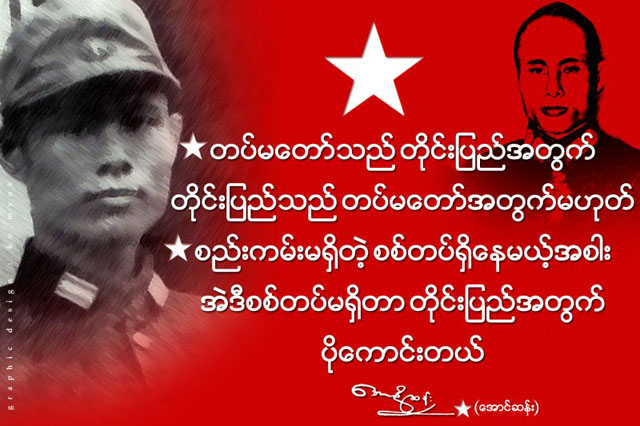
Honoring Martyrs of Burma: Burma Democratic Concern (BDC)
19 July 2010
On July 19, 1947 at approximately 10:37am, Burma Standard Time, several of Burma’s independence leaders were gunned down by the pro-colonialists while they were holding a cabinet meeting at what was known as ‘The Secretariat’ in down-town Rangoon.
The assassinated cabinet members were Bo Gyoke (General) Aung San, Thakin Mya, Dedoke U Ba Cho, U Razak, U Ba Win, Mahn Ba Khaing and Mai Pong Sawphwa Sao San Htun. Cabinet secretary U Ohn Maung and a bodyguard called Maung Htwe were also killed in the shooting.
Since then on July 19, the Burma Martyrs’ Day is observed to commemorate Bo Gyoke Aung San and six other independence leaders who were assassinated on that day in 1947.
But nowadays in Burma, military junta downgraded Burma Martyrs’ day in order to eliminate the true history of Burma independence heroes who truly sacrifice their lives for the betterment of the country opposite to those today military dictators.
The junta fears that due to the influence of the Bogyoke Aung San, who is the founding father of the modern day military as well as the architect of Burma’s independence, people love Daw Aung San Suu Kyi.
So they wanted to remove all the images, history and records relating to Bogyoke Aung San so that they unwisely believe that people will forget Bogyoke Aung San as well as Daw Aung San Suu Kyi.
But, in reality the spirits of Burma’s Martyrs are in our blood, in our soul and in our body and we will never bow down to neither imperialist, fascists nor military dictatorship in shaping our country future.
In order to keep alight the torch of Bogyoke Aung San and Martyrs’ spirit, Burma Democratic Concern (BDC) will commemorate the Martyrs’ Day on 19 July 2010 from 17:00 – 20:00 in London, UK. You are cordially invited to join with us.
For more information please contact;
Myo Thein [United Kingdom]
Phone: 00-44-208-493-9137, 00-44-787- 788-2386
Khin Maung Win [United States]
Phone: 001-941-961-2622
Daw Khin Aye Aye Mar [United States]
Phone: 001 509 586 8309
U Tint Swe Thiha [United States]
Phone: 001-509-582-3261, 001-509-591-8459
PS: Informative and Inspiring Speeches by the Burma Democracy Leaders, Ethnics Leaders, and Religious Leaders, Martyrs’ Day Honouring Live Songs, Martyrs’ Day Honouring Poems, Reading Short Biography of Martyrs, Discussion on Current Situation of Burma, and Questions Time. Refreshment will be provided. Please come and join with us.
http://bdcburma.org/Index.asp
Sunday, 18 July 2010
Wednesday, 14 July 2010
Monday, 12 July 2010
Burma's paranoid dictator plots his dignified exit
Burma's paranoid dictator plots his dignified exit
Senior-General Than Shwe is giving his regime a makeover as he calculates the safest way to step down. Peter Popham reports
In the run-up to a long promised but still unscheduled general election, the first for 20 years, Burma's military dictator, Senior-General Than Shwe, has taken a step full of peril: he has ordered his uniformed cabinet ministers to resign from the army.
Those faceless generals who adorn the front page of the New Light of Myanmar, the regime's daily paper, inspecting fish-packing factories and barrages, will still be running the country, and anything resembling democratic governance will be as far away as ever.
But the look of things will have changed. The ministers will wear longyi, the traditional Burmese sarong-like garment. And crucially for them, they will no longer enjoy the status and respect which, in a country ruled with an iron fist by the military for half a century, is the army's prerogative.
Irrawaddy, the expatriate Burmese news website, predicts trouble. "Senior-General Than Shwe is facing a mutiny among his subordinates," it claimed last week. "There are growing signs of discontent among his cabinet ministers... They have been betrayed by their boss.
"Like it or not, army uniforms are a symbol of authority in Burma," it went on. "Those who wear them always get priority over those who don't. They are respected and can expect easy co-operation from others. Suddenly they will lose that privilege."
Leaving the army also means that those ministers will not be included in the 25 per cent quota that the army has reserved for itself in the planned new parliament. "Now they are on their own," Irrawaddy columnist Bamargyi pointed out. "Unless Than Shwe supports them with some dirty deals from behind the scenes, they are sure to lose. Once this happens, they are down the drain."
In trying to rebrand his military dictatorship as a civilian administration, the 77-year-old soldier who has been the boss of his nation of 50 million people for the past 18 years, and who was recently named by the journal Foreign Affairs as the world's third-worst dictator after Kim Jong-il and Robert Mugabe, thus faces a major challenge.
And in trying to withdraw from the scene while remaining in control, he faces an even tougher test: how, as King Lear deludedly put it, to "shake all cares and business from our age,/ Conferring them on younger strengths, while we/ Unburden'd crawl towards death"? How to do that without getting the Goneril and Regan treatment – or much worse?
How, in other words, to live out the rest of his days enjoying the billions he has plundered from the state, without ending up like his late boss Ne Win, Burma's dictator from 1962 to 1988, who, on Than Shwe's orders, ended his life locked in his lakeside villa in Rangoon under house arrest while his sons languished in jail under sentence of death?
How to avoid the fate of Khin Nyunt, the military intelligence chief and for many years Than Shwe's number two, who is also under house arrest with no prospect of release (while some of his underlings were tortured to death) after China hailed him as "Burma's Deng Xiaoping"?
According to Ben Rogers, author of the first-ever biography, Than Shwe: Unmasking Burma's Tyrant, which is launched in London next week, acute anxiety about his security is behind the fact that, two years after announcing elections, the senior general has yet to say when they will be held.
"He wants to make sure that everything is sewn up perfectly and that he can continue to govern from behind the scenes," said Rogers, a human rights advocate with Christian Solidarity Worldwide. "He will hold off naming the date until he's certain he's got all his ducks in a row. He doesn't want to give the candidates any room for campaigning."
A similarly secretive, paranoid approach dictated the most extraordinary decision of Than Shwe's career, and the one which, for good or ill, will assure him immortality of a sort: the removal of Burma's capital from Rangoon to a hot, malaria-infested, seismically sensitive wasteland in the centre of the country.
The idea of moving the army's HQ out of Rangoon had been in the air for a number of years, and may have been mentioned by Than Shwe to Aung San Suu Kyi in one of the fruitless meetings they held in 1994, while the opposition leader was under her first spell of house arrest. Rangoon is in the far south; for an army engaged in multiple counter-insurgency operations in the north and east, a base in the centre made strategic sense.
But unbeknownst to the outside world, Than Shwe nursed a far more drastic plan. "At precisely 6.37 am on 6 November 2005," writes Rogers, "hundreds of government servants left Rangoon in trucks shouting, "We are leaving! We are leaving!" ... Five days later, a second convoy of 1,100 military trucks carrying 11 military battalions and 11 ministries left Rangoon. Perhaps influenced by astrologers, Than Shwe had decided to move the country's capital. He had given government officials just two days' notice."
So Naypyitaw, which translates as "Seat of Kings" and is dominated by oversize statues of Than Shwe's favourite royal forerunners, will be this man's monument. "It's the most awful place you've ever been to," said Mark Canning, a former British ambassador to Burma. "It's a collection of buildings scattered over scrubland. But they are all just dispersed, and there are two or three kilometres between each building. One can only presume it's so they don't get bombed or something, to spread out the targets." As a resident of Naypyitaw told one foreign journalist, "Although [Than Shwe] is a king, he is afraid of many things. He thinks that here he will be safe."
Naypyitaw thus incarnates what Suu Kyi once said about fear. "It is not power that corrupts, but fear," she noted in 1990 when she was already under house arrest. "Fear of losing power corrupts those who wield it, and fear of the scourge of power corrupts those who are subject to it... Fear slowly stifles and destroys all sense of right and wrong."
Only in a system dominated by fear could a man like Than Shwe rise to the top and stay there, because throughout his career he has given the impression of being so unimpeachably mediocre as to be without ambition or hope of success. He was a man incapable of provoking fear until suddenly he was at the top of the tree, and now he has held his nation in thrall for nearly two decades.
The comments of those who have had dealings with him are uniformly unflattering. "Short and fat with not a strong voice," says one. "Relatively boring," says another. "No evident personality." "Our leader is a very uneducated man." "There were many intelligent soldiers but he was not one of them...a bit of a thug." "You feel that he's got there by accident..." The closest Than Shwe gets to being complimented is in the description of a former World Bank official: "He is such an old fox!"
Born in 1933 in the central Burmese town of Kyaukse, Than Shwe quietly rose through the ranks despite having no striking military successes, until he was appointed deputy defence minister in July 1988 in the midst of the biggest revolt since the military takeover, the regime's moment of greatest danger.
In 1990 he was there alongside the erratic, sometimes deranged General Saw Maung, head of the new State Law and Order Restoration Council, who once drew his pistol on fellow generals during a game of golf and was eventually deposed. Then it was a contest between Than Shwe and military intelligence chief Khin Nyunt – who crucially had no experience as a commander in the field, and thus no chance of being accepted as chief by the army. Eventually Khin Nyunt, too, was flung from the battlements, a denouement waiting to happen. "Every single chief of military intelligence in Burma has been disgraced," said a former ambassador. "It's rather like being the drummer in Spinal Tap – you end up disappearing."
Than Shwe's mediocrity may have had its effect on Western attitudes towards him: he is easily under- estimated. As Rogers points out, he "has demonstrated time and again his skill at offering just enough of a concession to hold the international community at bay whenever pressure intensifies...Each time the pressure eases, Than Shwe quietly abandons his promises."
Meanwhile at home he has continued on the path set by his former superior Ne Win decades back: hugely expanding the size of the army, which now includes tens of thousands of children in its ranks, and continuing the campaigns of quasi-genocidal terrorism against the Karen and other ethnic minorities.
According to Sergio Pinheiro, UN Special Rapporteur on human rights in Burma from 2000 to 2008, writing in 2009, "Over the past 15 years the Burmese Army has destroyed over 3,300 villages in a systematic and widespread campaign to subjugate ethnic groups." At the same time he has kept Burma's civilian population in poverty and hopelessness. The only "reforms" he has pushed for have had the aim of perpetuating military rule under a disguise that fools nobody.
It is safe to predict that sooner or later Than Shwe will get his come-uppance. It may come from his immediate subordinates, furious at being kicked out, and an army that has never held him in esteem. The civil servants of Naypyitaw, incandescent at being exiled from the civilised comforts of Rangoon, may play their part. The monks, whom he arrogantly and foolishly refused to appease in 2007, could have a role.
But however certain his eventual downfall, you would have to be a very brave optimist to predict that he will be replaced by someone significantly better.
The general in brief
Born in 1933, Than Shwe joined the army at 20. He became Burma's top military leader in 1992 – four years after thousands of protesters had been massacred in Rangoon. The reclusive 77-year-old is thought to be superstitious, often consulting astrologers. In 2007, his new Burmese constitution effectively barred opposition leader Aung San Suu Kyi from office. Some credit the general with negotiating ceasefires with ethnic rebel armies, although he has also been accused of brutally suppressing minorities. He has been linked with high-level government purges, including that of Prime Minister General Khin Nyunt in 2004.
http://www.independent.co.uk/news/world/asia/burmas-paranoid-dictator-plots-his-dignified-exit-2024395.html
Senior-General Than Shwe is giving his regime a makeover as he calculates the safest way to step down. Peter Popham reports
In the run-up to a long promised but still unscheduled general election, the first for 20 years, Burma's military dictator, Senior-General Than Shwe, has taken a step full of peril: he has ordered his uniformed cabinet ministers to resign from the army.
Those faceless generals who adorn the front page of the New Light of Myanmar, the regime's daily paper, inspecting fish-packing factories and barrages, will still be running the country, and anything resembling democratic governance will be as far away as ever.
But the look of things will have changed. The ministers will wear longyi, the traditional Burmese sarong-like garment. And crucially for them, they will no longer enjoy the status and respect which, in a country ruled with an iron fist by the military for half a century, is the army's prerogative.
Irrawaddy, the expatriate Burmese news website, predicts trouble. "Senior-General Than Shwe is facing a mutiny among his subordinates," it claimed last week. "There are growing signs of discontent among his cabinet ministers... They have been betrayed by their boss.
"Like it or not, army uniforms are a symbol of authority in Burma," it went on. "Those who wear them always get priority over those who don't. They are respected and can expect easy co-operation from others. Suddenly they will lose that privilege."
Leaving the army also means that those ministers will not be included in the 25 per cent quota that the army has reserved for itself in the planned new parliament. "Now they are on their own," Irrawaddy columnist Bamargyi pointed out. "Unless Than Shwe supports them with some dirty deals from behind the scenes, they are sure to lose. Once this happens, they are down the drain."
In trying to rebrand his military dictatorship as a civilian administration, the 77-year-old soldier who has been the boss of his nation of 50 million people for the past 18 years, and who was recently named by the journal Foreign Affairs as the world's third-worst dictator after Kim Jong-il and Robert Mugabe, thus faces a major challenge.
And in trying to withdraw from the scene while remaining in control, he faces an even tougher test: how, as King Lear deludedly put it, to "shake all cares and business from our age,/ Conferring them on younger strengths, while we/ Unburden'd crawl towards death"? How to do that without getting the Goneril and Regan treatment – or much worse?
How, in other words, to live out the rest of his days enjoying the billions he has plundered from the state, without ending up like his late boss Ne Win, Burma's dictator from 1962 to 1988, who, on Than Shwe's orders, ended his life locked in his lakeside villa in Rangoon under house arrest while his sons languished in jail under sentence of death?
How to avoid the fate of Khin Nyunt, the military intelligence chief and for many years Than Shwe's number two, who is also under house arrest with no prospect of release (while some of his underlings were tortured to death) after China hailed him as "Burma's Deng Xiaoping"?
According to Ben Rogers, author of the first-ever biography, Than Shwe: Unmasking Burma's Tyrant, which is launched in London next week, acute anxiety about his security is behind the fact that, two years after announcing elections, the senior general has yet to say when they will be held.
"He wants to make sure that everything is sewn up perfectly and that he can continue to govern from behind the scenes," said Rogers, a human rights advocate with Christian Solidarity Worldwide. "He will hold off naming the date until he's certain he's got all his ducks in a row. He doesn't want to give the candidates any room for campaigning."
A similarly secretive, paranoid approach dictated the most extraordinary decision of Than Shwe's career, and the one which, for good or ill, will assure him immortality of a sort: the removal of Burma's capital from Rangoon to a hot, malaria-infested, seismically sensitive wasteland in the centre of the country.
The idea of moving the army's HQ out of Rangoon had been in the air for a number of years, and may have been mentioned by Than Shwe to Aung San Suu Kyi in one of the fruitless meetings they held in 1994, while the opposition leader was under her first spell of house arrest. Rangoon is in the far south; for an army engaged in multiple counter-insurgency operations in the north and east, a base in the centre made strategic sense.
But unbeknownst to the outside world, Than Shwe nursed a far more drastic plan. "At precisely 6.37 am on 6 November 2005," writes Rogers, "hundreds of government servants left Rangoon in trucks shouting, "We are leaving! We are leaving!" ... Five days later, a second convoy of 1,100 military trucks carrying 11 military battalions and 11 ministries left Rangoon. Perhaps influenced by astrologers, Than Shwe had decided to move the country's capital. He had given government officials just two days' notice."
So Naypyitaw, which translates as "Seat of Kings" and is dominated by oversize statues of Than Shwe's favourite royal forerunners, will be this man's monument. "It's the most awful place you've ever been to," said Mark Canning, a former British ambassador to Burma. "It's a collection of buildings scattered over scrubland. But they are all just dispersed, and there are two or three kilometres between each building. One can only presume it's so they don't get bombed or something, to spread out the targets." As a resident of Naypyitaw told one foreign journalist, "Although [Than Shwe] is a king, he is afraid of many things. He thinks that here he will be safe."
Naypyitaw thus incarnates what Suu Kyi once said about fear. "It is not power that corrupts, but fear," she noted in 1990 when she was already under house arrest. "Fear of losing power corrupts those who wield it, and fear of the scourge of power corrupts those who are subject to it... Fear slowly stifles and destroys all sense of right and wrong."
Only in a system dominated by fear could a man like Than Shwe rise to the top and stay there, because throughout his career he has given the impression of being so unimpeachably mediocre as to be without ambition or hope of success. He was a man incapable of provoking fear until suddenly he was at the top of the tree, and now he has held his nation in thrall for nearly two decades.
The comments of those who have had dealings with him are uniformly unflattering. "Short and fat with not a strong voice," says one. "Relatively boring," says another. "No evident personality." "Our leader is a very uneducated man." "There were many intelligent soldiers but he was not one of them...a bit of a thug." "You feel that he's got there by accident..." The closest Than Shwe gets to being complimented is in the description of a former World Bank official: "He is such an old fox!"
Born in 1933 in the central Burmese town of Kyaukse, Than Shwe quietly rose through the ranks despite having no striking military successes, until he was appointed deputy defence minister in July 1988 in the midst of the biggest revolt since the military takeover, the regime's moment of greatest danger.
In 1990 he was there alongside the erratic, sometimes deranged General Saw Maung, head of the new State Law and Order Restoration Council, who once drew his pistol on fellow generals during a game of golf and was eventually deposed. Then it was a contest between Than Shwe and military intelligence chief Khin Nyunt – who crucially had no experience as a commander in the field, and thus no chance of being accepted as chief by the army. Eventually Khin Nyunt, too, was flung from the battlements, a denouement waiting to happen. "Every single chief of military intelligence in Burma has been disgraced," said a former ambassador. "It's rather like being the drummer in Spinal Tap – you end up disappearing."
Than Shwe's mediocrity may have had its effect on Western attitudes towards him: he is easily under- estimated. As Rogers points out, he "has demonstrated time and again his skill at offering just enough of a concession to hold the international community at bay whenever pressure intensifies...Each time the pressure eases, Than Shwe quietly abandons his promises."
Meanwhile at home he has continued on the path set by his former superior Ne Win decades back: hugely expanding the size of the army, which now includes tens of thousands of children in its ranks, and continuing the campaigns of quasi-genocidal terrorism against the Karen and other ethnic minorities.
According to Sergio Pinheiro, UN Special Rapporteur on human rights in Burma from 2000 to 2008, writing in 2009, "Over the past 15 years the Burmese Army has destroyed over 3,300 villages in a systematic and widespread campaign to subjugate ethnic groups." At the same time he has kept Burma's civilian population in poverty and hopelessness. The only "reforms" he has pushed for have had the aim of perpetuating military rule under a disguise that fools nobody.
It is safe to predict that sooner or later Than Shwe will get his come-uppance. It may come from his immediate subordinates, furious at being kicked out, and an army that has never held him in esteem. The civil servants of Naypyitaw, incandescent at being exiled from the civilised comforts of Rangoon, may play their part. The monks, whom he arrogantly and foolishly refused to appease in 2007, could have a role.
But however certain his eventual downfall, you would have to be a very brave optimist to predict that he will be replaced by someone significantly better.
The general in brief
Born in 1933, Than Shwe joined the army at 20. He became Burma's top military leader in 1992 – four years after thousands of protesters had been massacred in Rangoon. The reclusive 77-year-old is thought to be superstitious, often consulting astrologers. In 2007, his new Burmese constitution effectively barred opposition leader Aung San Suu Kyi from office. Some credit the general with negotiating ceasefires with ethnic rebel armies, although he has also been accused of brutally suppressing minorities. He has been linked with high-level government purges, including that of Prime Minister General Khin Nyunt in 2004.
http://www.independent.co.uk/news/world/asia/burmas-paranoid-dictator-plots-his-dignified-exit-2024395.html
Sunday, 11 July 2010
Naypyidaw plague and dengue outbreaks infect troops, children
Naypyidaw plague and dengue outbreaks infect troops, children
Mizzima news
10 July 2010
Chiang Mai (Mizzima) – Outbreaks of plague and dengue fever are spreading through military units in Naypyidaw, the Burmese military regime’s seat of government, according to a military hospital source.
Infected soldiers were admitted to the new 1,000-bed military hospital in Naypyidaw for treatment. Moreover diarrhoea and dengue fever is spreading among residents in the capital’s neighbouring township of Pyinmana, home to 100,000 people.
“Children under-12 [of soldiers] in these Naypyidaw military units infected with dengue fever and plague were admitted to the children’s hospital and the troops infected with dengue and plague and their children over 12 were admitted here,” an officer from the military hospital, who requested anonymity, told Mizzima.
He declined to give further details on the scale of the epidemic.
According to official government figures released last year, Naypyidaw, meaning Royal City, is the third largest city in Burma, with a population of 925,000.
The outbreaks emerge after hundreds of thousands of rodents were reported late last month migrating from their current habitats.
“Mice are moving ‘in their thousands’ away from lakes and reservoirs in central Burma’s Bago and Mandalay divisions and towards urban areas. One man reported seeing fleets of mice on the Mandalay-to-Naypyidaw highway,” an exile media outlet reported on June 30.
In a sign of unusual openness by the junta, Ministry of Health plague warnings were seen in state-run papers on July 1 and 2.
The warning said: “Sudden death of mice may be because of plague. The people are advised to report and send the dead mice suspected of being infected with plague to the nearest health department”.
However, Dr. Khin Aye Myint from the Social Welfare dispensary in Pyinmana disagreed with any contact with the mice and offered a safer solution.
“The Health Department should instigate a public awareness campaign on plague and dead mice. If suspected, the dead mice should be poured with petrol and burned or should be reported to health department,” Dr. Khin Aye Myint said.
Reuters news agency reported on Wednesday that the Burmese Ministry of Health had also circulated a warning among government departments about rat-borne plague after finding infected dead rodents near a government office in Naypyidaw, an official said.
Moreover residents of Yauktharinn, Kanoo, Yanaung (2) and Shwechi wards in Pyinmana said that diarrhoea and dengue fever were spreading in their locality.
Previously it infected children aged between 5 and 12 but elderly people were now also being infected.
“Some dengue fever patients visited nearby clinics and could recover within one or two days. Some of them were referred to hospitals. There are also many patients suffering from diarrhoea,” a brokerage owner in Yaukthuarinn Ward told Mizzima.
The virus that causes dengue fever is carried by mosquitoes.
Wet, humid weather during the monsoon has encouraged breeding of mosquito larvae in drains, ponds and garbage dumps, which encouraged the breeding of flies and mosquitos and the subsequent spreading of the bacterias that cause diarrhoea through contaminated foods and the virus that causes dengue, Dr. Khin Myint Aye said.
Dengue spreads because of our inability to fight the mosquito menace, he said.
Dengue outbreaks are not rare in Burma. Ministry of Health announced that 910 people were infected with dengue during the January-May period and six those died from this disease that is also known as break-bone fever because of severe pain in the bones and joints that often characterises infection.
At least 80 people were infected in Rangoon in the last week of June, Mizzima reported on July 1.
According to official statistics, 3,129 Burmese people were infected with dengue last year and 37 died.
Mizzima news
10 July 2010
Chiang Mai (Mizzima) – Outbreaks of plague and dengue fever are spreading through military units in Naypyidaw, the Burmese military regime’s seat of government, according to a military hospital source.
Infected soldiers were admitted to the new 1,000-bed military hospital in Naypyidaw for treatment. Moreover diarrhoea and dengue fever is spreading among residents in the capital’s neighbouring township of Pyinmana, home to 100,000 people.
“Children under-12 [of soldiers] in these Naypyidaw military units infected with dengue fever and plague were admitted to the children’s hospital and the troops infected with dengue and plague and their children over 12 were admitted here,” an officer from the military hospital, who requested anonymity, told Mizzima.
He declined to give further details on the scale of the epidemic.
According to official government figures released last year, Naypyidaw, meaning Royal City, is the third largest city in Burma, with a population of 925,000.
The outbreaks emerge after hundreds of thousands of rodents were reported late last month migrating from their current habitats.
“Mice are moving ‘in their thousands’ away from lakes and reservoirs in central Burma’s Bago and Mandalay divisions and towards urban areas. One man reported seeing fleets of mice on the Mandalay-to-Naypyidaw highway,” an exile media outlet reported on June 30.
In a sign of unusual openness by the junta, Ministry of Health plague warnings were seen in state-run papers on July 1 and 2.
The warning said: “Sudden death of mice may be because of plague. The people are advised to report and send the dead mice suspected of being infected with plague to the nearest health department”.
However, Dr. Khin Aye Myint from the Social Welfare dispensary in Pyinmana disagreed with any contact with the mice and offered a safer solution.
“The Health Department should instigate a public awareness campaign on plague and dead mice. If suspected, the dead mice should be poured with petrol and burned or should be reported to health department,” Dr. Khin Aye Myint said.
Reuters news agency reported on Wednesday that the Burmese Ministry of Health had also circulated a warning among government departments about rat-borne plague after finding infected dead rodents near a government office in Naypyidaw, an official said.
Moreover residents of Yauktharinn, Kanoo, Yanaung (2) and Shwechi wards in Pyinmana said that diarrhoea and dengue fever were spreading in their locality.
Previously it infected children aged between 5 and 12 but elderly people were now also being infected.
“Some dengue fever patients visited nearby clinics and could recover within one or two days. Some of them were referred to hospitals. There are also many patients suffering from diarrhoea,” a brokerage owner in Yaukthuarinn Ward told Mizzima.
The virus that causes dengue fever is carried by mosquitoes.
Wet, humid weather during the monsoon has encouraged breeding of mosquito larvae in drains, ponds and garbage dumps, which encouraged the breeding of flies and mosquitos and the subsequent spreading of the bacterias that cause diarrhoea through contaminated foods and the virus that causes dengue, Dr. Khin Myint Aye said.
Dengue spreads because of our inability to fight the mosquito menace, he said.
Dengue outbreaks are not rare in Burma. Ministry of Health announced that 910 people were infected with dengue during the January-May period and six those died from this disease that is also known as break-bone fever because of severe pain in the bones and joints that often characterises infection.
At least 80 people were infected in Rangoon in the last week of June, Mizzima reported on July 1.
According to official statistics, 3,129 Burmese people were infected with dengue last year and 37 died.
Friday, 9 July 2010
Subscribe to:
Posts (Atom)